A crypto off-ramp API converts stablecoins such as USDC and USDT into fiat money and delivers it to a bank account. On Swipelux, each customer holds stablecoins in a custodial wallet. Once the customer is verified and the wallet funded, a payout in USD, EUR or another currency takes three requests: save the bank account, create a quote, and execute the quote as a transfer. The fee is 0.01–0.5% of each transfer.
How to pay out USDC to a bank account: the requests
Every payout debits a funded wallet that Swipelux issues for the customer, so no payout needs its own deposit address. In the API this is a payout with the direction stablecoin_to_fiat, which the API derives from the quote's two currencies.
Create the customer, read GET /v3/customers/{customerId}/capabilities/supported and request an entry whose directions include payout. Its id, ach_pooled here, is the quote's capabilityId. Then create the wallet:
POST /v3/customers/{customerId}/accounts
{
  "origin": "issued",
  "type": "wallet",
  "currency": "USDC",
  "network": "base",
  "label": "Settlement wallet"
}
Every request carries your X-API-Key. Every POST needs an Idempotency-Key: a new one for each operation, and the same one when you retry it. The Sandbox helpers in step 5 take none.
1. Save the bank account
When the customer owns the bank account, save it as an external account. methods names the rails it accepts:
POST /v3/customers/{customerId}/accounts
{
  "origin": "external",
  "type": "bank",
  "methods": ["ach", "wire"],
  "country": "US",
  "currency": "USD",
  "details": {
    "routingNumber": "021000021",
    "accountNumber": "123456789",
    "accountType": "checking",
    "bankName": "Example Bank",
    "accountHolderName": "Acme Payments SAS"
  }
}
A euro account takes sepa and an IBAN:
POST /v3/customers/{customerId}/accounts
{
  "origin": "external",
  "type": "bank",
  "methods": ["sepa"],
  "country": "DE",
  "currency": "EUR",
  "details": {
    "iban": "DE89370400440532013000",
    "accountHolderName": "Acme Payments GmbH"
  }
}
The response holds an acc_ ID and a status. Read the account again and quote only when its status permits the payout. Swipelux checks routing numbers, IBANs and BICs for format, not that the account exists or who owns it.
2. Create a quote
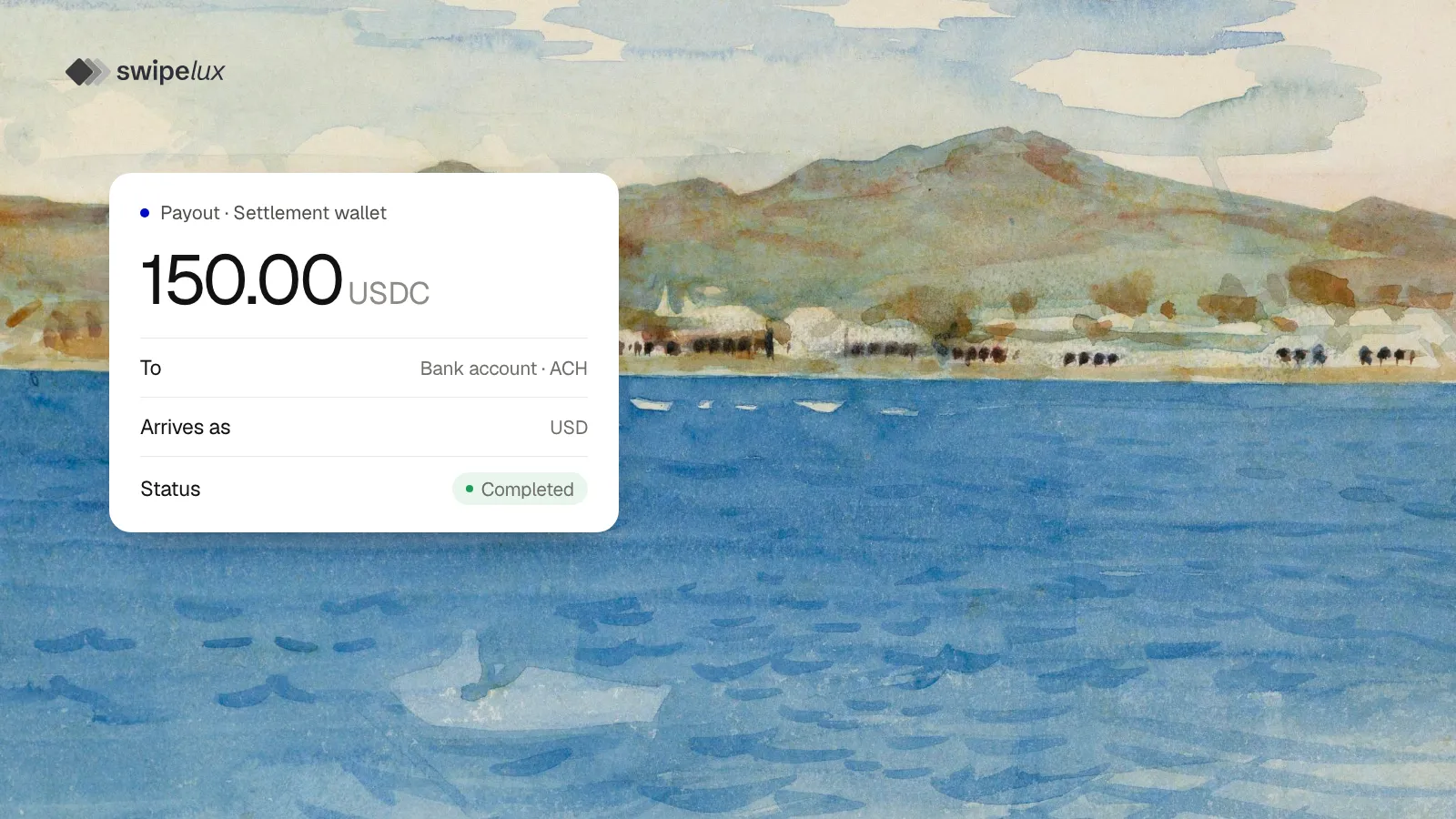
in.accountId is the wallet, and destinationId is the bank account:
POST /v3/quotes
{
  "customerId": "cus_...",
  "capabilityId": "ach_pooled",
  "in": {
    "amount": "150.00",
    "currency": "USDC",
    "accountId": "acc_..."
  },
  "destinationId": "acc_...",
  "out": { "currency": "USD" }
}
The response returns both amounts, a rate, a fees list and expiresAt. To fix the amount that arrives, send out.amount and omit in.amount. A quote is single-use: execute it before expiresAt. For USDT by ACH or wire, the wallet's currency and in.currency are USDT.
3. Execute the quote as a transfer
POST /v3/transfers
{
  "quoteId": "quo_..."
}
If the response is lost, repeat the same request with the same Idempotency-Key. A successful response starts the payout. It does not prove delivery.
4. Follow the transfer by webhook
Subscribe to transfer.state_changed with POST /v3/webhooks. Each change sends an event:
{
  "id": "evt_...",
  "type": "transfer.state_changed",
  "createdAt": "2026-11-20T12:30:00.000Z",
  "attempt": 1,
  "resource": { "type": "transfer", "id": "tr_..." },
  "data": {
    "object": {
      "id": "tr_...",
      "customerId": "cus_...",
      "state": "completed",
      "createdAt": "2026-11-20T12:00:00.000Z",
      "updatedAt": "2026-11-20T12:30:00.000Z"
    },
    "previous": { "state": "processing" }
  }
}
A transfer's state is one of awaiting_funds, processing, action_required, completed, failed or canceled. Delivery is at least once, so events can repeat. Verify the signature, store the event id, then read GET /v3/transfers/{transferId}.
5. Test the payout in Sandbox
With a sandbox key, no real funds move. Set the capability to ready, top up the wallet, run the same quote and transfer, then set the outcome, completed or failed:
POST /v3/sandbox/customers/{customerId}/capabilities/{capabilityId}/status
{ "status": "ready" }

POST /v3/sandbox/accounts/{accountId}/topup
{ "amount": "250.00", "currency": "USDC" }

POST /v3/sandbox/transfers/{transferId}/state
{ "state": "completed" }
In Sandbox, ACH, wire and SWIFT capabilities are served at JPMorgan Chase only, and foreign-currency SWIFT payouts cannot be tested. The other direction, fiat in and USDC out, is in the card on-ramp with Apple Pay and Google Pay.
First-party or third-party payout: which destination do you need?
The customer's own bank account is an external account, quoted by its acc_ ID, for ACH, wire, SEPA and SWIFT. Another person's or business's account is a recipient destination, quoted by its dst_ ID. Pix, SPEI, Transfers 3.0 and Colombian bank accounts (destination type pse) exist only as recipient destinations, so those payouts always take a dst_ ID.
A recipient records who receives funds, and a destination records where:
POST /v3/customers/{customerId}/recipients
{
  "type": "business",
  "relationship": "vendor",
  "companyName": "Example Supplier LLC",
  "address": {
    "streetLine1": "1 Market Street",
    "city": "San Francisco",
    "state": "CA",
    "postalCode": "94105",
    "country": "US"
  }
}

POST /v3/customers/{customerId}/recipients/{recipientId}/destinations
{
  "type": "ach",
  "currency": "USD",
  "details": {
    "routingNumber": "021000021",
    "accountNumber": "123456789",
    "accountType": "checking",
    "bankName": "Example Bank",
    "accountHolderName": "Example Supplier LLC",
    "country": "US"
  }
}
A bank destination needs a ready capability for its method, or the request returns 409 rail_not_ready. Quote with the dst_ ID once the destination's status is ready, not with the recipient's rcp_ ID.
The bank can hold a USD SWIFT payout to a third party until it receives a supporting document, such as an invoice or contract. The transfer then shows action_required, and a task with category: "transaction_rfi" asks for one document and its reference. Payouts to the customer's own account never get this task. See first-party vs third-party payments.
Which currencies and rails can stablecoin payouts reach?
Stablecoin payouts on Swipelux reach bank accounts in USD by ACH, wire and SWIFT, EUR by SEPA, BRL by Pix, MXN by SPEI, ARS by Transfers 3.0, and COP in Colombian bank accounts (pse in the API). The capability in the quote sets the rail, and the account or destination has to accept it.
| Currency | Rail (methods or type value) | Account identifier | Note |
|---|---|---|---|
| USD | ACH or wire: ach, wire | routingNumber, accountNumber | USDC or USDT |
| USD | SWIFT: swift | swiftCode, accountNumber, bank street address | At least 100.00 USD after fees |
| EUR | SEPA: sepa | iban | BIC is optional |
| BRL | Pix: pix or pix_safe | pixKey, or taxId and bank account | Recipient only, USDC only |
| MXN | SPEI: spei | clabe, 18 characters | Recipient only |
| COP | Bank account: pse | bankCode, accountNumber, holder's document | Recipient only |
| ARS | Transfers 3.0: transfers_3_0 | cbu, 22 characters | Recipient only |
USDT funds USD payouts by ACH and wire, and by SWIFT from Ethereum or Polygon. USD SWIFT also takes USDC on Ethereum, Base or Polygon.
With a ready Lead Bank swift_named capability, SWIFT pays out in 17 more currencies, among them EUR, GBP, CAD, AUD, CHF and JPY. The bank decides which each customer can use. Those quotes take an exact USDC in.amount and return an estimated out.amount.
Swipelux issues wallets for USDC and USDT on Base, Ethereum, Polygon and Solana. To require one bank route, add institutionId to the quote. Countries are on the coverage page. ACH vs wire vs RTP vs SWIFT compares the bank rails, and Pix, SPEI and PSE covers payouts in Brazil, Mexico and Colombia.
Exchange withdrawal, OTC desk or off-ramp API: which fits a business?
An off-ramp API fits a business that pays its customers and third parties. An exchange withdrawal goes to the bank account linked to the exchange account: Coinbase Prime's API, for example, withdraws fiat to a bank account you first link in the Prime UI. A crypto OTC desk settles a large conversion at an agreed price.
| Way | Who it suits | How a payout starts | Where the money goes |
|---|---|---|---|
| Exchange withdrawal | A company cashing out its own balance | You sell, then withdraw | The linked bank account |
| OTC desk | Large conversions at an agreed price | You ask the desk for a price | Accounts agreed with the desk |
| Off-ramp API | Platforms paying customers or suppliers | Your code sends a quote and a transfer | Own, customer or third-party accounts |
Issuers redeem directly. Circle says USDC is always redeemable 1:1 for US dollars, and offers Circle Mint to institutional customers, not individuals. Tether's fee schedule sets a 100,000 USD minimum per redemption, a fee of the greater of 1,000 USD or 0.1%, and a 150 USD verification fee.
What does an exchange, OTC desk or wallet app need from an off-ramp?
In Swipelux sales calls with fintech companies from May to November 2026, about one company in seven opened by asking how to convert stablecoins into bank money. An exchange, OTC desk or wallet app needs three kinds of payout. On Swipelux, each customer whose stablecoins you pay out is a Swipelux customer with its own wallet:
- To your own treasury account. Your company is the customer and its bank account an external account, as in moving company money between the bank and stablecoins.
- To your customer's own bank account, saved as an external account under that customer.
- To a third party, such as a supplier your customer pays. That is a recipient with a
dst_destination.
Send each customer's stablecoins to their Swipelux wallet, where deposits are screened before funds move.
Onboarding comes first: the KYB policy estimates 2–5 business days for a standard review and 5–10 with enhanced due diligence, and names crypto exchanges among the verticals that can need it. Your own platform typically goes live one to three weeks after complete documents. Each open task lists the documents it needs: see KYB requirements and documents. For volume pricing or a currency that is not listed, talk to sales.
What does a crypto to fiat payout cost, and how long does it take?
Swipelux charges one transaction fee of 0.01–0.5% per transfer, set by corridor and volume, and prices verification per check: KYC per person, KYB per business. Outgoing bank and network charges pass through at cost. The FX rate and spread are in the quote before you execute. Pay as you go has no platform fee and no volume commitment. A Sandbox quote on the Swipelux agents page prices 250.00 USDC at 249.10 USD by ACH, a 0.90 USDC fee.
Add your own fee per customer account, or per quote with fees.breakdown.developer: a fixed amount and bips, where 50 means 0.50%. A Pix payout cannot carry a developer fee.
Typical times once a transfer is sent, by payout rail:
| Payout rail | Typical time |
|---|---|
| ACH | 1–2 business days |
| Wire | Same business day |
| SWIFT | 1–3 business days |
| SEPA | Same or next business day |
| Pix | Seconds, around the clock |
| SPEI | Minutes |
Colombian bank account (pse) | Same day |
| Transfers 3.0 | Minutes |
| USDC or USDT leg | Minutes, around the clock |
Which rules apply when you convert stablecoins to fiat?
Three sets of rules apply to a platform that pays out its customers' stablecoins: US money transmission law, the Travel Rule and the US stablecoin law.
- Money transmission. FinCEN's 2019 guidance defines it as accepting currency, funds or other value that substitutes for currency from one person and transmitting it to another location or person by any means. Exchangers generally qualify, it says, and users do not. A money transmitter must register with FinCEN and run an AML programme with recordkeeping, monitoring and reporting.
- The Travel Rule for crypto. The FATF expects a virtual asset service provider to obtain, hold and securely transmit originator and beneficiary information when it makes a transfer. A platform that sends its customers' stablecoins to Swipelux wallets is the one making that transfer. By July 2026, 83% of surveyed jurisdictions had passed Travel Rule laws, the FATF reported.
- Payment stablecoins. The US GENIUS Act, signed on July 18, 2025, takes effect on January 18, 2027, the OCC says. From then, permitted issuers must hold reserves on an at least 1 to 1 basis. From July 18, 2028, a digital asset service provider may not offer or sell a payment stablecoin to a person in the United States unless a permitted issuer issued it, with an exception for foreign issuers in section 18.
Questions people ask
Can I pay out USDT to a bank account, not only USDC?
Yes for USD. USDT funds ACH and wire payouts, and USD SWIFT payouts from Ethereum or Polygon. Pix payouts in BRL and foreign-currency SWIFT payouts take USDC only.
Which crypto to fiat API lets an OTC desk wire USD to a third party?
Swipelux lets an OTC desk wire USD to a third party. Each client of the desk is a Swipelux customer with a wallet for USDC or USDT. Save the third party as a recipient, add a wire or swift destination and quote with its dst_ ID. A client with a named account can send the payout under its own name. On USD SWIFT, the bank can ask for an invoice or contract first, in a transaction_rfi task.
How do we convert USDC to USD and settle it to our own bank account automatically?
Make your company the Swipelux customer and save its bank account as an external account. Your code creates a quote and a transfer when each deposit's webhook arrives. A Swipelux rule cannot: one that targets a bank destination returns 400 rule_target_invalid. The fee is 0.01–0.5% plus bank charges at cost, and a wire typically arrives the same business day. Converting your own USDC into your own bank account is not money transmission as FinCEN's 2019 guidance defines it: the definition covers value accepted from one person and transmitted to another, and the guidance says users acting on their own behalf are not money transmitters.
Do I need a money transmitter license to off-ramp for my customers?
A business that accepts convertible virtual currency from one person and transmits it to another is a money transmitter under FinCEN's 2019 guidance, unless exempt, and must register within 180 days of starting. That registration is federal. States license separately: New York requires a BitLicense for virtual currency business activity, and a BitLicensee that also transmits dollars needs a separate money transmission licence.
Do we have to verify our customers again if we already ran KYC?
Individuals do not repeat the ID document and selfie steps when you already verify them in your own account with the identity verification provider Swipelux uses: a share token imports those documents, and Swipelux runs its checks again. Business clients go through KYB, which the import does not cover.
Is there a limit on how much one payout can be?
Limits are set per customer. A quote or transfer that would pass the customer's remaining daily or monthly allowance at the bank returns 409 customer_bank_limit_exceeded. Lower the amount, wait for the reset, or ask support for a higher allowance.
What is the smallest stablecoin deposit a wallet credits?
1 unit of the stablecoin, for a deposit you did not announce. Smaller deposits are treated as dust. Each credited deposit appears as a transfer with origin: "inbound_deposit".
What happens when a payout fails, is returned, or the bank asks for documents?
A failed payout ends in failed with a reason in stateDetail. When the bank needs something, the state becomes action_required and openTaskIds lists the tasks. A payout the receiving bank returns after completion stays completed and gains a correction of kind return, which Swipelux reviews.
Start now
- Sign up for Swipelux. Sandbox is ready right away.
- Create a customer and a wallet, top the wallet up, and save a bank account.
- Create a quote and a transfer, then follow the payout by webhook.
Building with Claude Code or Codex? The Swipelux wizard has your coding agent add payouts to your app and test them in Sandbox.