ACH is the batch rail for US payments that can wait a day. A wire over Fedwire settles one payment at a time and is final. RTP delivers in seconds at any hour, up to $10 million. SWIFT is the only one that reaches a bank abroad. A platform without SWIFT details cannot be paid by a buyer whose bank is abroad, and some providers offer SWIFT only for payouts.
Two limits changed in 2025. The Clearing House raised the RTP limit from $1 million to $10 million on February 9, 2025, and the Federal Reserve raised the FedNow limit from $500,000 to $1 million in June 2025 and to $10 million in November 2025. An older page, or an AI answer built on one, still says $1 million.
Which rail for which payment on a B2B trade payment platform
On a B2B trade payment platform, the rail follows where the other bank is and how soon money must be final:
- Buyer in Europe: SWIFT into USD details in the seller's name, or SEPA for a euro invoice.
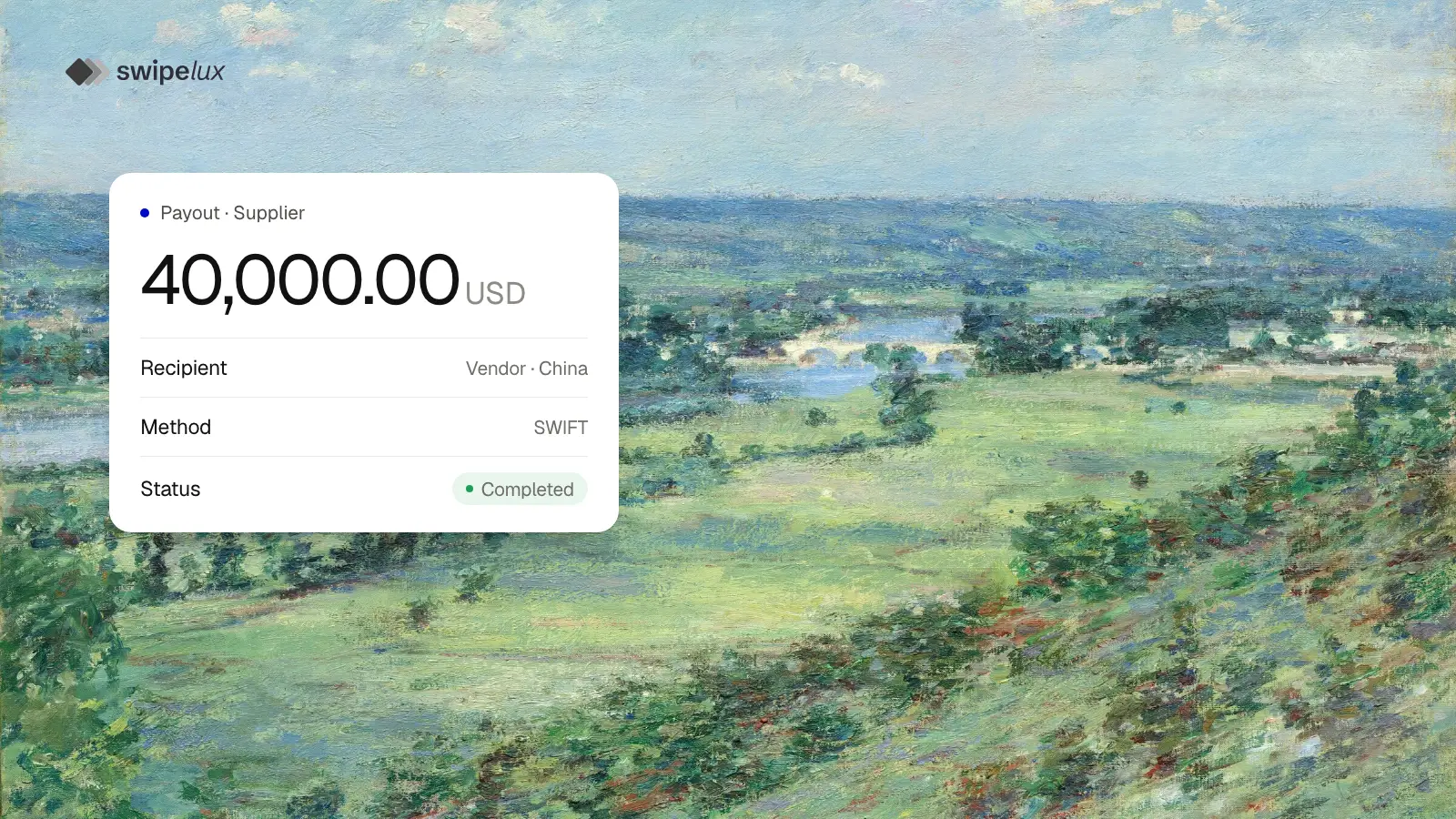
- Supplier in China: SWIFT in USD, with the bank's BIC and street address.
- Buyer in the US: ACH when the invoice can wait a day, a wire when goods ship on payment, RTP at night or on a weekend.
- US supplier paid the same day: RTP or FedNow when both banks are on the network, Same Day ACH up to $1 million before 4:45 p.m. ET, a wire above that. On Swipelux, a wire.
- Payroll batch: ACH, sent ahead of payday.
In Swipelux sales calls from May to November 2026, platforms named two gaps at their current provider: no SWIFT at all, or SWIFT payouts but no SWIFT pay-ins. To go through your corridors and volumes with us, talk to sales.
What is the difference between ACH and a wire transfer?
ACH is not a wire transfer. ACH settles payments in batches, four times a business day, and some of them can come back. A wire settles one payment at a time and cannot be undone once processed. ACH can also pull money from an account. A wire only pushes.
ACH is the Automated Clearing House network. It runs under Nacha's rules and reaches all US bank and credit union accounts. A standard payment is scheduled for the next business day or the one after, and Same Day ACH settles within hours.
Fedwire is the Federal Reserve's wire system. The Fed describes it as a real-time gross settlement system whose transfers are immediate, final and irrevocable once processed.
RTP compared with ACH and a wire
RTP is the instant payment network run by The Clearing House. An RTP payment reaches the recipient within seconds, weekends and bank holidays included, and the sending bank cannot revoke or recall it once submitted.
RTP is faster than ACH but reaches fewer accounts: both banks must be on the network, which had over 1,420 participants in October 2026. Against a wire, RTP wins on hours: Fedwire is closed on weekends and holidays, and the Fed has approved opening it on Sundays and weekday holidays no earlier than 2028.
Is a wire transfer the same as SWIFT?
No. A wire transfer is a bank-to-bank payment sent one at a time, and SWIFT is the messaging network banks use to send payment instructions across borders. An international wire goes over SWIFT. A domestic wire over Fedwire does not.
Fedwire vs SWIFT
Fedwire moves dollars between accounts held at the Federal Reserve Banks. Swift has more than 11,500 members, banks and large companies, that message each other about cross-border transactions. ACH, Fedwire and RTP connect accounts at US institutions, so a buyer whose bank is outside the US needs SWIFT details for your client's account.
The four payment rails side by side: speed, hours, limits and reversibility
The first table gives each network's own limit. On Swipelux, limits are set per customer: a quote returns customer_bank_limit_exceeded when a payment is over the customer's allowance at the bank.
| Rail | Speed | Hours and cut-off | Network limit |
|---|---|---|---|
| ACH | Next business day or the one after; Same Day ACH in hours | Business days; last Same Day ACH window 4:45 p.m. ET | $1 million for Same Day ACH |
| Wire (Fedwire) | Immediate once processed | Monday to Friday; customer payments until 6:45 p.m. ET | $10 billion |
| RTP | Seconds | 24/7/365, no cut-off | $10 million since February 9, 2025 |
| FedNow | Instant | Around the clock, every day | $10 million since November 2025 |
| SWIFT | Over 90% reach the beneficiary bank within one hour; the credit to the account can follow the next working day | Each bank's own hours | Set by the banks |
| Rail | Can it be reversed? | Best use |
|---|---|---|
| ACH | In defined cases: the receiving bank can return it, and the sender can reverse its own error | Payroll batches, recurring invoices, debits |
| Wire (Fedwire) | No. It is final once processed | Large US payments due today |
| RTP | No. The sending bank cannot revoke or recall it | Urgent US payments, nights and weekends |
| SWIFT | Not by the sender alone. Banks can send a stop and recall request | Suppliers and buyers abroad |
What are the Same Day ACH and Fedwire cut-off times?
The FedACH schedule sets three Same Day ACH cut-off times: 10:30 a.m., 2:45 p.m. and 4:45 p.m. ET, settling at 1:00 p.m., 5:00 p.m. and 6:00 p.m. ET.
The Same Day ACH limit is $1 million per payment. A payment above it is not rejected: it settles the next day. Nacha bars splitting one obligation into several same-day payments, but separate invoices to one supplier can each go as their own payment. The limit rises to $10 million on September 17, 2027.
The Fedwire cut-off for a customer's wire transfer is 6:45 p.m. ET, and your bank sets its own before that. An international wire has no single cut-off time: each bank on the route keeps its own hours.
How long does a SWIFT transfer take?
An international wire sent over SWIFT reaches the receiving bank within minutes in most cases, then takes as long as that bank needs to credit the account. Swift's network data shows 75% of payments reach the beneficiary bank within 10 minutes and over 90% within one hour. Of payments on Swift GPI, nearly 60% are credited to the end beneficiary within 30 minutes and almost 100% within 24 hours.
The last mile, from the beneficiary bank to the recipient's account, takes over 80% of the total time, and a transfer can stall twice. On the way, an intermediary bank can stop it: OFAC holds a US bank responsible for blocking a wire it knows involves a sanctioned party, even when the bank only passes it on. Swift counts 86% of its messages as direct or through one intermediary.
After arrival, Swift's causes of delay are purpose-of-payment reporting, currency controls, batch or business-hours processing, and incomplete payment data. In China, the foreign exchange regulations have banks examine the authenticity of the documents behind a trade receipt, so the supplier should have the contract and invoice at hand.
To trace a payment, ask for its UETR. A UETR is a string of 36 characters carried in every payment instruction sent over Swift. It works like a courier tracking number: any bank in the chain can use it to locate the payment.
What is MT103, and what replaced it?
An MT103 is the SWIFT message that instructs a single customer payment from one bank to another. Since 22 November 2025 Swift requires ISO 20022 for payment instructions between banks, where the same instruction is a pacs.008 message. As a temporary, paid contingency, Swift still converts an MT 103 that a bank sends. Fedwire uses pacs.008 for a customer transfer too.
Suppliers still ask for the MT103 as evidence that a payment was sent. Under either label, the copy shows that the instruction left the sending bank, not that the recipient was credited, so send the UETR with it.
ACH, wire, RTP and SWIFT on Swipelux
Swipelux issues bank details in each client's legal name at partner banks JPMorgan Chase, Citi, CFSB, Lead Bank, Portage Bank or Zenus Bank, for ACH, wire and SWIFT. The API returns the banks and methods each client is eligible for, and you pick among those. With SWIFT, clients receive and send USD to and from more than 100 countries, and through Lead Bank pay out in EUR, GBP and 15 other currencies. Every deposit is converted and credited to the client's USDC or USDT wallet, and every payout is quoted from that wallet. RTP is for collecting only, through pooled details, for business clients.
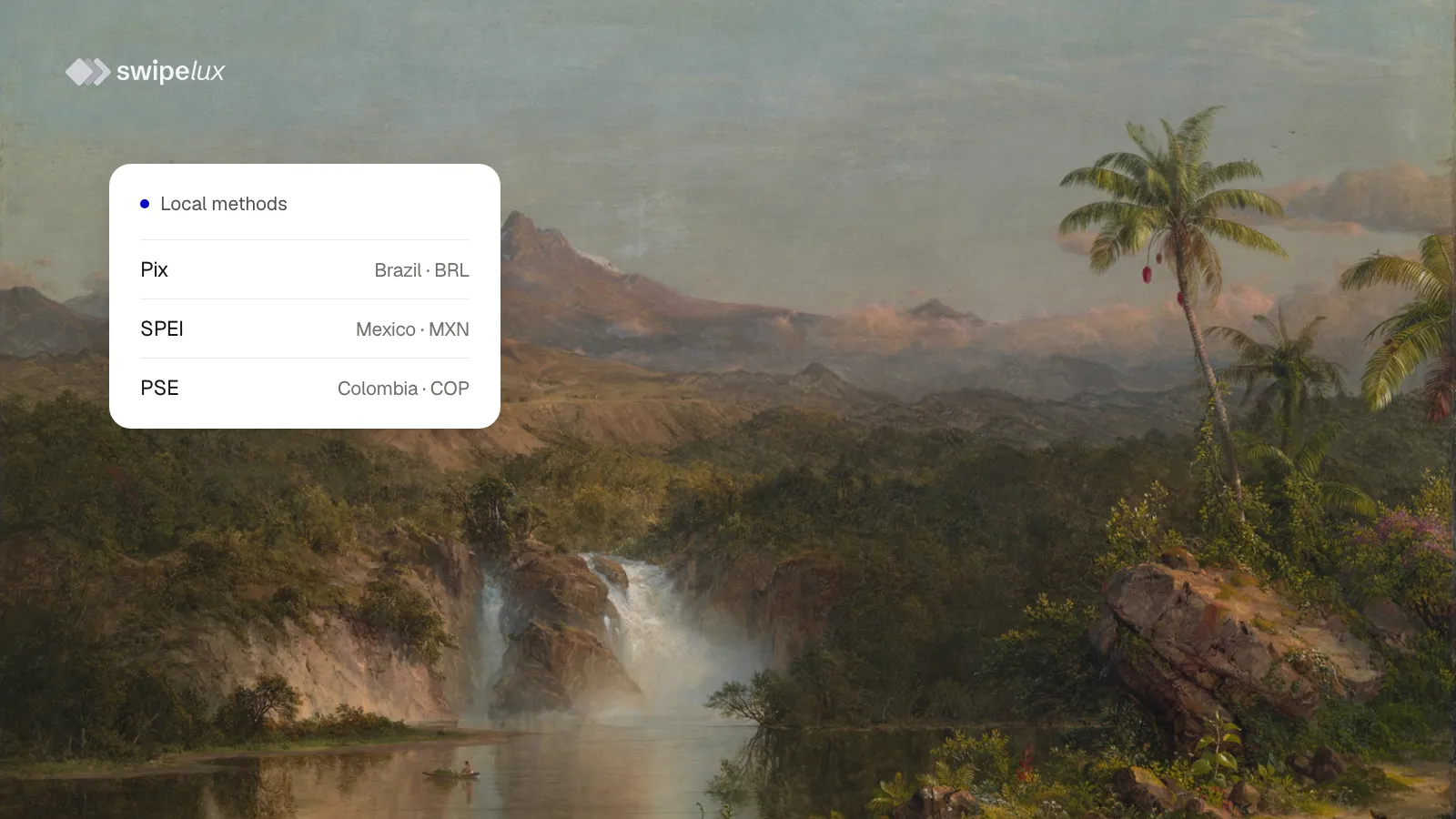
Clients collect by ACH, wire, RTP, SWIFT and SEPA, plus local methods in Latin America (Pix, SPEI and PSE), and pay out to their own account or to third-party recipients. The API has no FedNow method.
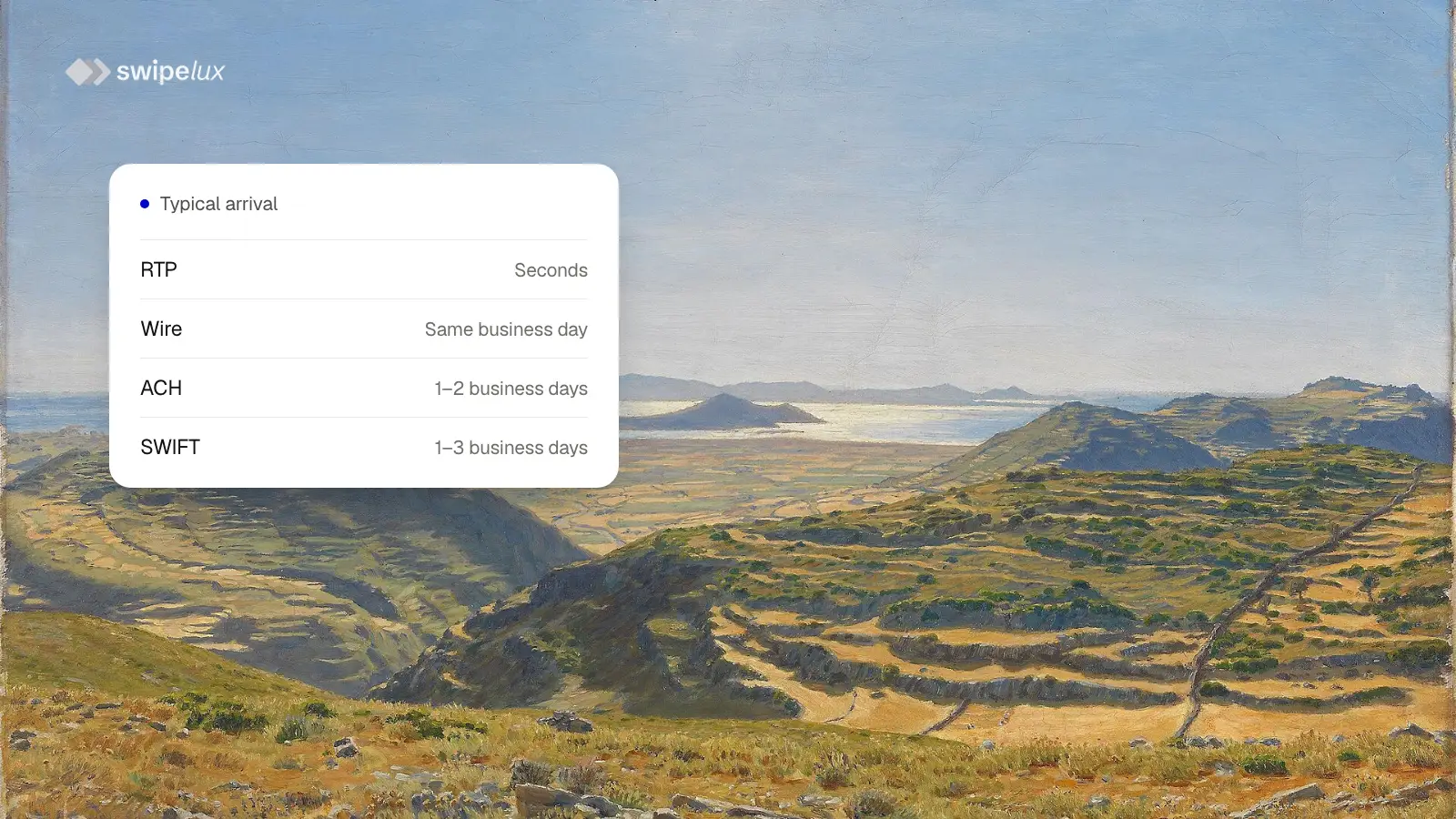
Typical arrival once a transfer is sent: an RTP pay-in in seconds, around the clock; a wire the same business day; ACH in 1 to 2 business days; SWIFT in 1 to 3 business days.
How a transfer names its rail in the Swipelux API
The Swipelux API names the rail in four places: method on a capability, on an issued account and on a transfer, and type on a recipient's destination. Every request carries your X-API-Key. Every POST shown here carries an Idempotency-Key: one per operation, and the same one when you retry it. To receive SWIFT the client needs the swift_named capability; swift_pooled covers payouts only. Then issue a bank account with the method the payer uses, at a bank the supported-capability response lists for that client:
POST /v3/customers/{customerId}/accounts
{
  "origin": "issued",
  "type": "bank",
  "method": "swift",
  "currency": "USD",
  "institution": "jpmorgan",
  "settlement": { "accountId": "acc_..." }
}
To pay a supplier abroad, create the recipient, then add a destination whose type is the rail. A USD SWIFT payout needs the bank's street address as well as its BIC:
POST /v3/customers/{customerId}/recipients/{recipientId}/destinations
{
  "type": "swift",
  "currency": "USD",
  "details": {
    "swiftCode": "EXMPCNBJ",
    "accountNumber": "1234567890123456",
    "bankName": "Example Bank",
    "bankAddress": "1 Example Road",
    "bankCity": "Beijing",
    "bankState": "Beijing",
    "bankPostalCode": "100000",
    "accountHolderName": "Example Trading Co., Ltd.",
    "country": "CN"
  }
}
details also takes intermediaryBankSwift for an intermediary bank. Then quote and execute. A USD SWIFT payout is funded from USDC on Ethereum, Base or Polygon, or USDT on Ethereum or Polygon. The quote fixes the dollars sent and returns the USDC that leaves the wallet:
POST /v3/quotes
{
  "customerId": "cus_...",
  "capabilityId": "swift_named",
  "in": { "currency": "USDC", "accountId": "acc_..." },
  "destinationId": "dst_...",
  "out": { "amount": "40000.00", "currency": "USD" }
}

POST /v3/transfers
{
  "quoteId": "quo_..."
}
Read the transfer after every transfer.state_changed webhook. It returns the rail in method and its progress in state, and stateDetail names the reason and the party that has to act. When the bank asks for the invoice or contract behind a USD SWIFT payout to a third party, the transfer turns action_required, and a task with category: "transaction_rfi" asks for one document and its reference. Payouts to the client's own account never get this task. For bank rails the references object defines three tracking fields: traceNumber (an ACH trace number or wire reference), imad and uetr.
Questions people ask
Can a wire transfer be reversed?
No, not by the sender. Once Fedwire processes a transfer, the sending bank can only send a return request (camt.056), and the receiving bank can send the money back as a separate return payment (pacs.004). RTP has no recall either, only a request for return of funds.
Can an ACH payment be reversed?
Yes, in limited cases. Nacha's rules let the sender reverse its own error: a duplicate, a wrong amount, a wrong date or an unintended account. The reversal must go out within five banking days of settlement and match the original amount, and it is returned if the money has left the account.
Does one account take both ACH and wires?
At some banks, yes. In the Swipelux API you request an issued account with one method. Some issued accounts then list both in a methods array, ["ach", "wire"], and their details carry achRoutingNumber and wireRoutingNumber when the bank uses separate routing numbers.
SEPA vs SWIFT: which one for a euro payment?
SEPA inside Europe. SEPA Credit Transfer carries euro payments between accounts in 41 countries, and SEPA Instant delivers them in under ten seconds. SWIFT covers euro payments outside that area.
Can a buyer abroad pay into a US account by SWIFT?
Yes, when the account has SWIFT details. On Swipelux an issued swift account returns them: the bank's name and BIC, the account number, and the account holder's name and address. The buyer's bank must copy that address exactly, along with any intermediary bank the details list and, when details.referenceRequired is true, the exact details.reference.
Why did a SWIFT payment arrive short?
Because a bank on the route, or the receiving bank, deducted its fee. That happens to a buyer's payment as well as to a payout. On the transfer Swipelux creates for a deposit, amounts.in is the amount received, and sender carries the payer's name and bank when the bank supplies them.
Is a client tied to one bank?
No. On Swipelux each client has one application per bank, and a rejection at one bank does not affect the application at another. A client approved at more than one partner bank can hold named details at each.
What does a SWIFT payout cost on Swipelux?
One transaction fee of 0.01% to 0.5% per transfer, set by corridor and volume, plus the outgoing bank charge at cost. Both are in the quote. A USD SWIFT payout must deliver at least 100.00 USD.
Start now
- Sign up for Swipelux; Sandbox is ready right away.
- Create a customer, list the supported capabilities and request the methods you need.
- Add a recipient and a destination, then create a quote and a transfer.