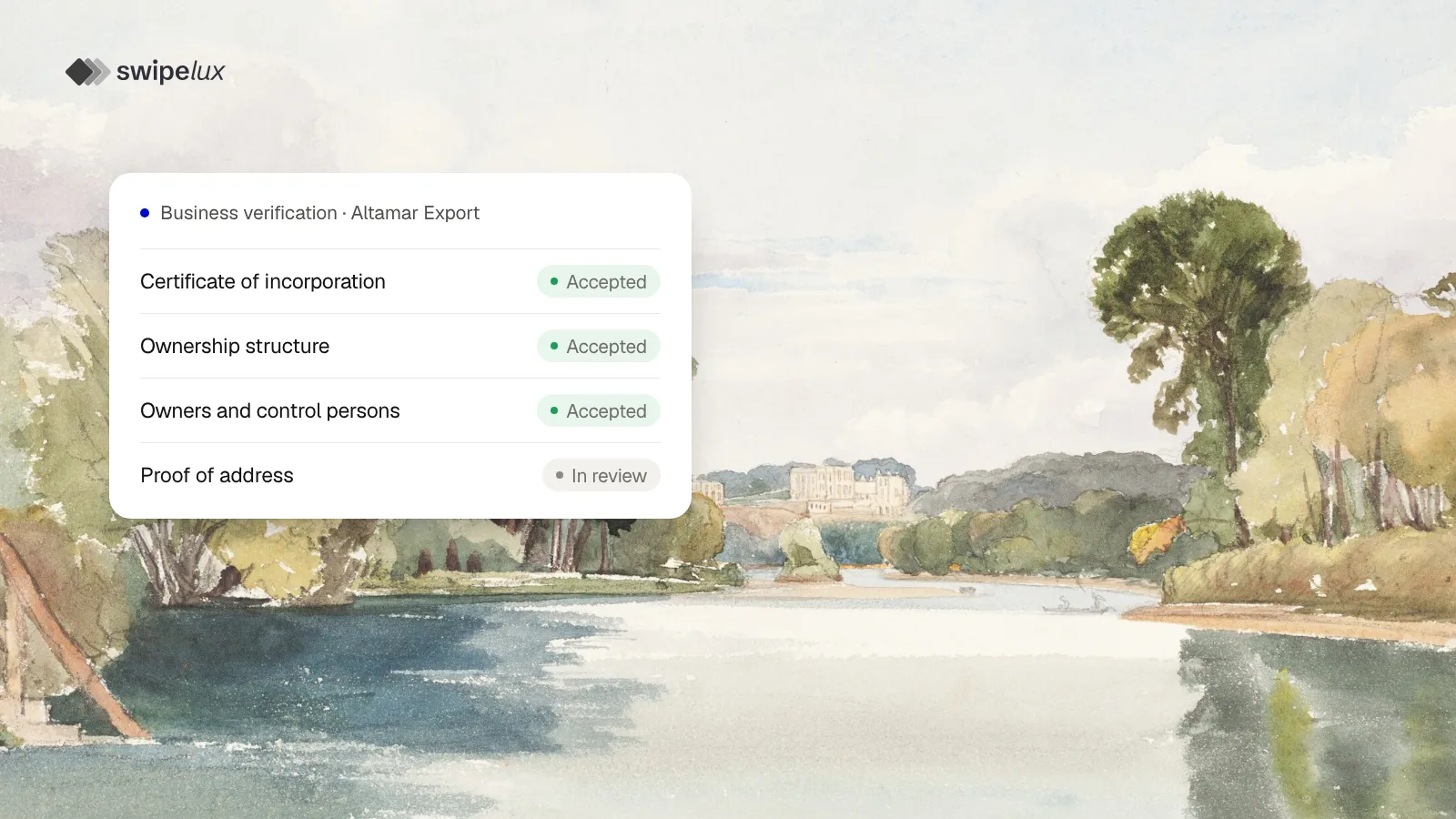
KYB (Know Your Business) requirements are what a bank asks a business for before it opens an account: a formation document (articles of organization for an LLC, certificate of incorporation for a corporation), registration number and tax ID, ownership documents that account for 100% of the company, an ID for each 25% owner and control person, proof of the applicant's authority, and proof of address.
Files come back over details. A self-made cap table is dated and signed; one exported from Carta, AngelList or Securitize needs no signature. A shareholder ledger is signed by a control person, an ownership chart by a lawyer or third-party CPA. On Swipelux, a document one partner bank accepted answers the same request at another.
Which documents are required for KYB?
Swipelux's KYB policy sorts what a bank asks a business for into six groups of documents: formation, ownership structure, directors and control persons, authority to act, proof of address, and identity documents for the people it names. Registration country and number, formation date and tax ID are profile fields, not files; the tax ID has a type: ssn, itin, ein, tin, vat, cpf, cnpj or other.
| What is checked | Accepted documents | What gets it sent back |
|---|---|---|
| Formation | Certificate of incorporation or the entity type's formation document | Name differs from the register; company dissolved; document expired |
| Ownership structure | Cap table, shareholders' agreement, stock certificates, shareholder ledger, an LLC's operating agreement, ownership org chart | Shares do not add up; parent companies missing; self-made document unsigned or undated |
| Directors and control persons | Board resolution, annual report, bylaws, board minutes, register of directors, certificate of incumbency | A director, executive officer or 25% owner left out |
| Authority to act | Power of attorney, board resolution or authorization letter | Applicant is no director or officer and shows no authority |
| Business proof of address | Bank statement, utility bill, government letter or rent receipt from the last 90 days; a current office lease | PO box, virtual office alone, mobile phone bill, insurance document |
| Identity of owners and control persons | Passport, national identity card or driver's licence; proof of address where asked | Expired ID; number or issuing country missing; proof of address over 90 days old |
A request can also ask for a certificate of good standing, articles of association, a business licence, financial statements or tax returns.
Formation documents by entity type
The names below are US ones. A company formed elsewhere sends the equivalent document filed with its own government registry, in the registered legal name.
| Entity type | Formation document |
|---|---|
| Corporation | Articles of Incorporation or Certificate of Incorporation |
| Limited liability company (LLC) | Articles of Organization or Certificate of Formation |
| Partnership | Partnership Agreement or Certificate of Partnership |
| Limited partnership | Certificate of Limited Partnership |
| Sole proprietorship | Business License, DBA Filing or Trade Name Registration |
| Nonprofit | Articles of Incorporation and IRS Determination Letter (501(c)(3)) |
| Trust | Trust Deed or Certificate of Trust |
| Cooperative | Articles of Incorporation or Bylaws |
Under the Customer Identification Program (CIP) rule for banks (31 CFR 1020.220), a U.S. company gives its taxpayer identification number, an EIN. A foreign business with no identification number is asked for other government-issued documentation certifying that it exists.
Who counts as a UBO, and what is a control person?
A UBO (ultimate beneficial owner) is an individual who directly or indirectly owns or controls 25% or more of the business. A control person directs or significantly influences the business, whatever their ownership percentage.
Swipelux applies the 25% line in all supported countries, with two rules:
- Control persons are always named, also when no individual owns 25% or more: typically the CEO or managing director.
- If another company owns the business, provide ownership documents for each parent until you reach individuals. The structure accounts for 100%, including holdings below 25%.
FinCEN CDD Rule: who is a beneficial owner, and is 25% still in force?
Under the FinCEN CDD Rule (31 CFR 1010.230) a US bank identifies and verifies every individual who owns 25 percent or more of a legal entity, plus one individual who controls it: one to five people. The rule is in force. What ended in 2025 was beneficial ownership information (BOI) reporting to FinCEN by U.S. companies: an interim final rule of March 26, 2025, made permanent by a final rule effective August 14, 2026.
For banks, two things changed in 2026. FinCEN order FIN-2026-R001 of February 13 removed the duty to identify and verify owners again at every new account. On November 17 FinCEN proposed amendments (91 FR 74514) that keep the 25% and control tests.
Under the order a bank still identifies and verifies owners at a company's first account, when it learns facts that call the earlier information into question, and when its own risk procedures require. It may still ask every time. The proposal (comments close January 19, 2027; not in force) writes the order into the rule, lets a bank ask for more where risk warrants, including immigration status, and would stop accepting an ITIN in place of a Social Security number. A non-U.S. owner could still give a passport number and its country of issue.
25% is the rule's threshold; a bank may set a lower one. A foreign company registered to do business in a U.S. state still files BOI reports unless exempt. EU law draws the same line: 25% plus one share today, 25% or more from July 10, 2027.
KYB vs KYC: what differs for a platform?
KYB is documents you upload for a company and its owners. KYC is a hosted identity session that an individual customer completes.
| Topic | KYB (business) | KYC (individual) |
|---|---|---|
| How evidence is collected | Uploaded and submitted through the API, the dashboard or a shareable link | ID document, selfie and proof of address in the hosted session; proof of funds is uploaded |
| A verification you already ran | Not imported: reviewed from the documents you submit | Imported with a share token from your account at the same verification provider |
How long does KYB take?
For one business, Swipelux's KYB policy gives a typical duration for each stage: document upload is immediate, the initial review takes 1-2 business days, standard KYB 2-5 business days, and enhanced due diligence (EDD), where it is required, 5-10 business days. The policy gives no total. Added together, initial review and standard KYB come to 3 to 7 business days after upload; the policy does not say whether the stages run one after the other. These are estimates, not commitments.
The policy publishes one timeline, with no separate figures for companies formed in Europe or Latin America. What delays a file is EDD, or documents sent back because one is missing, a scan is unreadable, a name differs between documents, ownership does not add up, or a document has expired.
The policy says EDD may be required for five things: high-risk jurisdictions, high-risk verticals including gaming, trading and crypto exchanges, complex ownership structures, expected monthly volume above the applicable threshold (no figure is published), and operations involving sanctioned countries.
What happens when a bank sends KYB documents back?
The submission's outcome becomes changes_requested, and the requirement carries reviewFeedback: a code and a message. Upload a new file and submit again against the Task's current revision. An answer made only of files already returned is refused with documents_already_returned.
Swipelux reuses what it holds. A business has one application per bank, one approval can cover several capabilities, and a company document already accepted or in review answers a matching request at another bank unless it is too old. Owners' documents are not reused.
Send what you already know when you create the customer: requirements the profile already answers go straight to review. In our Sandbox test, the onboarding request asked for 13 things when only the customer's type was sent, and 2 with its profile.
Checklist: what to collect from each business before you submit
- Formation document for the entity type, in the registered legal name.
- Registration country and number, formation date, tax ID.
- Ownership document for the company and each parent company, dated and signed if self-made.
- Everyone who owns 25% or more, with the percentage; every control person, director and executive officer; a register of directors or board resolution.
- For each person the bank asks about: ID, its number and issuing country, proof of address.
- Business proof of address from the last 90 days, with its issue date, not a PO box.
- Power of attorney or authorization letter if the applicant is no director or officer.
- Operating countries, expected volumes, source and purpose of funds, licences.
- Scans: PDF, JPEG, PNG, WebP or HEIF/HEIC, up to 25 MB each.
How do KYB requests arrive, and how do you answer them?
Swipelux is a payments API where your platform submits each business customer's documents, reads what the bank still needs as Tasks on that customer, then opens USD account details in the customer's legal name. A Task is one request from Swipelux compliance or the partner bank: a list of requirements, each with its own status.
A capability is pending, restricted, ready, rejected or canceled. A Task is action_required, in_review, satisfied, rejected or canceled. Its dueAt date, 31 days after creation by default, is informational; only a deadline, when present, changes the Task automatically.
Every request carries X-API-Key. Every POST shown here carries an Idempotency-Key: one per operation, and the same one when you retry it. A Task's document requirement, abbreviated here, says what is accepted:
GET /v3/customers/{customerId}/tasks/{taskId}
{
  "data": {
    "id": "tsk_...",
    "status": "action_required",
    "revision": 3,
    "requirements": [
      {
        "id": "req_...",
        "status": "action_required",
        "request": {
          "type": "document",
          "prompt": "Upload a proof of address for the business.",
          "required": true,
          "acceptedDocumentTypes": ["bank_statement"],
          "constraints": { "maxIssueAgeDays": 90 }
        }
      }
    ]
  }
}
Upload the file with a type the requirement accepts. The response's data.id is the document ID:
curl --request POST \
  "https://platform.swipelux.com/v3/customers/${CUSTOMER_ID}/documents" \
  --header "X-API-Key: ${SWIPELUX_API_KEY}" \
  --header "Idempotency-Key: customer-document-001" \
  --form "type=bank_statement" \
  --form "file=@proof-of-address.pdf"
Then submit the answer. When the request sets maxIssueAgeDays, add each file's issue date:
POST /v3/customers/{customerId}/tasks/{taskId}/submissions
{
  "taskRevision": 3,
  "answers": [
    {
      "requirementId": "req_...",
      "answer": {
        "type": "document",
        "documentIds": ["doc_..."],
        "documentMetadata": [
          { "documentId": "doc_...", "issuedOn": "2026-10-28" }
        ]
      }
    }
  ]
}
Once every open requirement is answered, the Task's status is in_review. The submission has its own outcome: in_review until a decision, then accepted, changes_requested or rejected, or withdrawn if you take it back to correct it. Owners and control persons are added with POST /v3/customers/{customerId}/related-parties.
KYB for payment gateways, PSPs and B2B platforms
For a payment gateway, PSP or B2B platform, KYB happens at two levels: once for the platform itself, then once for every merchant (priced per check). Your own review covers company documents, ownership, licences, and AML and KYC approach, and typically takes one to three weeks from complete documents to live accounts, depending on your flows. Until it is approved, live requests that create customers, accounts or transfers return 422 merchant_kyb_not_approved. Then, for each merchant:
- See the questions first.
GET /v3/customers/{customerId}/capabilities/{capabilityId}/tasks-previewreturns the Tasks a capability would open, without creating anything. - Find who still owes documents.
GET /v3/customers?include=documentRequirementsreturns a conservative count of the mandatory documents each customer still owes; its Tasks hold the full list. - Open the account. When the capability is
ready, you issue USD bank details in the merchant's legal name (named, not pooled) at a partner bank: JPMorgan Chase, Citi, CFSB, Lead Bank, Portage Bank or Zenus Bank. The API lists the banks open to each merchant, and you pick among those. Each deposit is converted and credited to the merchant's USDC or USDT wallet.
Questions people ask
Can you onboard a company from my country?
Ask the API for each company. GET /v3/customers/{customerId}/capabilities/supported returns each capability with availability, eligibility.eligible and the partner banks open to that customer. A bank that does not take the company is listed in unavailableInstitutions with its reasons. The coverage page lists countries and methods.
Is a director or a signer a UBO?
Not by title. A director who owns less than 25% is not a UBO but is still recorded as a director, and a signer is not necessarily a control person. In the API a related party carries roles and, separately, ownership percentages.
Do UBOs and directors need their own KYC?
Owners of 25% or more, yes. At least one control person is always named. Whether a director or control person also sends an ID is set by the Task. Adding a beneficial owner as a related party opens that owner's own document requirements.
What happens if a bank rejects a business?
A review ends in approval, conditional approval with caps, or rejection. Applications at different banks are independent, so a rejection at one does not affect another. To try another partner bank, request the capability again with that bank's ID.
Is a business verified again later?
Not for each payment: KYB comes before a business customer can transact. Later, the bank can hold a USD SWIFT payout to a third party until it receives an invoice or contract, requested as a Task on the transfer. And archiving the last qualifying beneficial owner reopens the ownership requirement, even after the Task was satisfied.
How does my platform know a new request has opened?
Tasks have no webhook of their own. When capability.status_changed or application.status_changed arrives, read the capability again: its openTaskIds lists the open Tasks for that capability and its applications. A question about one transfer shows in that transfer's openTaskIds, and GET /v3/customers/{customerId}/tasks lists every Task for the customer.
Can we rehearse a KYB review before going live?
Yes, in Sandbox. POST /v3/sandbox/tasks creates a Task that asks for the documents you choose. You answer it as you would a live one, then accept or reject it yourself with POST /v3/sandbox/tasks/{taskId}/review.
Can an AI agent upload KYB documents?
Yes, through a link. Connected through the Swipelux MCP server, the agent creates a 15-minute upload link for the exact Task. You, or an agent running on your own computer, put one PDF or image of up to 4 MB through it (the API upload takes 25 MB), and the agent submits the Task.
Start now
- Sign up for Swipelux; Sandbox is ready right away.
- Create a business customer, add its owners, and request a capability.
- Read the open Tasks, upload each document and submit, or talk to sales.