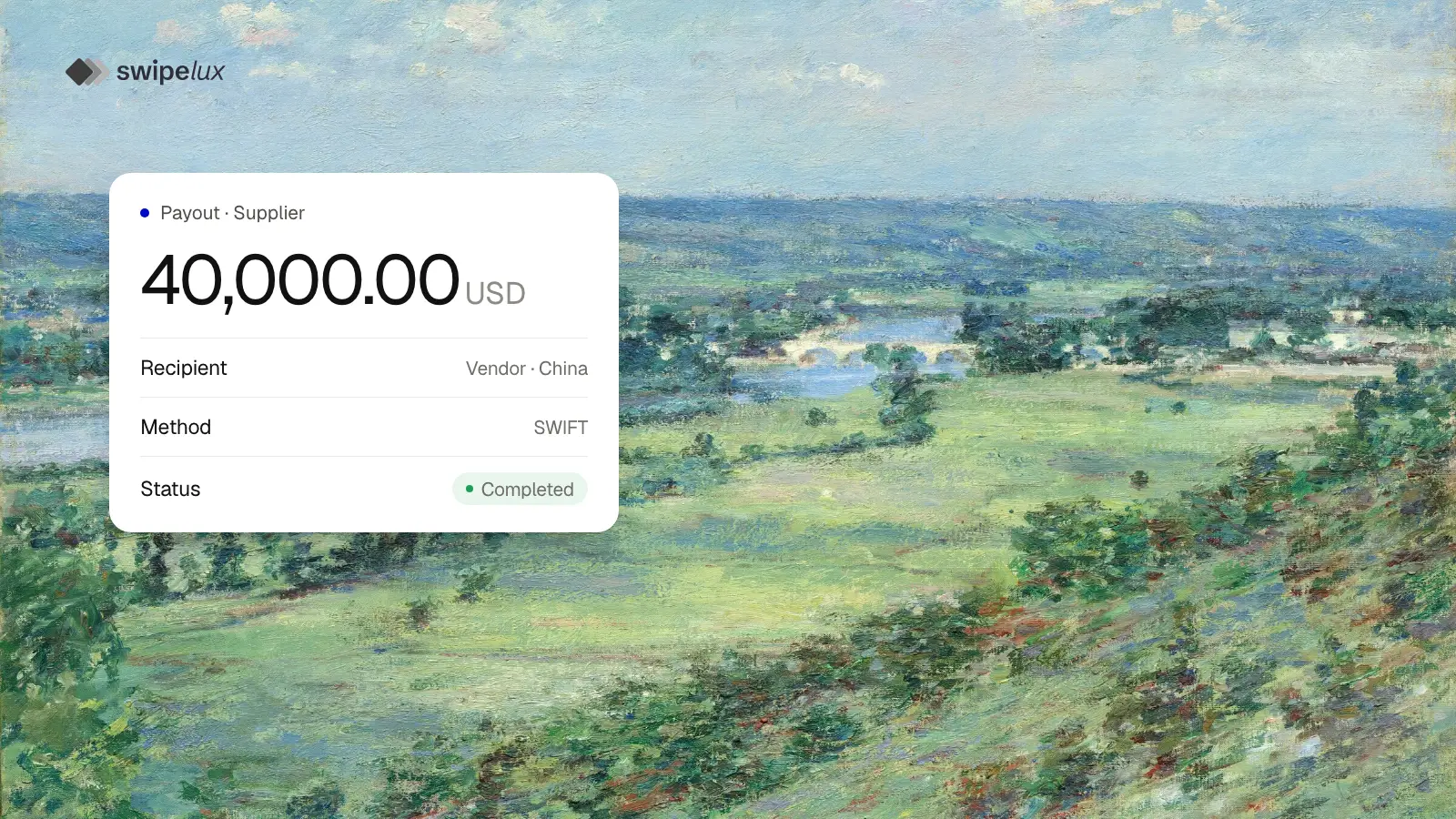
A first-party payment moves money between one owner's two accounts. In a third-party payment the payer or the payee is not the account holder: a buyer pays your client, or your client pays a supplier. Swipelux supports third-party flows in both directions: bank details in your client's legal name at one of six partner banks, open to any payer, and payouts from the client's wallet to recipients who are not the client.
What is a third-party payment?
A third-party payment is a payment where the payer or the payee is not the holder of the account the money moves through. A first-party payment is the opposite: one person or company owns both ends, as when a business funds its account from its own bank or withdraws to it.
First-party vs third-party payments: pay-ins and payouts compared
A pay-in and a payout can each be first-party or third-party. That gives four flows, and the bank asks a different question about each.
| Flow | Who sends, who receives | What the bank checks | Typical use |
|---|---|---|---|
| First-party pay-in | The account holder, from their own bank account | That the sender is the account holder | Funding a balance, treasury top-ups |
| Third-party pay-in | A buyer or customer, to the account holder | Who the payer is, why they pay, whether it fits expected activity | Invoices, export proceeds, marketplace sales |
| First-party payout | The account holder, to their own bank account or wallet | That the receiving account is in the account holder's name | Withdrawals, off-ramp to your own bank |
| Third-party payout | The account holder, to a supplier, contractor, seller or employee | Who the recipient is, the relationship, the purpose; an invoice or contract on request | Supplier payments, payroll, marketplace payouts |
On Swipelux the API shows the split for ACH, wire, SEPA and SWIFT: a first-party payout targets a customer account, an acc_ ID, and a third-party payout targets a recipient destination, a dst_ ID. Pix, SPEI and Transfers 3.0 payouts, and payouts to Colombian bank accounts (destination type pse), always use a recipient destination (see Pix, SPEI and PSE). At creation Swipelux checks bank identifiers for format on both, not who owns the account.
Why do providers allow only first-party transfers?
Providers allow only first-party transfers because a bank answers for the money that passes through its accounts, and in a third-party flow it has verified only one side: the account holder passed KYC or KYB; the buyer or the supplier did not. A provider that settles in stablecoins has a second reason: a bank payment can be returned or reversed after the deposit was converted and credited.
Two recent rules raise the cost of an unknown counterparty. Nacha's ACH fraud-monitoring rules took effect in two phases, on March 20 and June 22, 2026, and make receiving banks monitor incoming credits for fraud. FATF's 18 June 2025 revision of Recommendation 16 standardises the payer and payee information sent with peer-to-peer cross-border payments above USD/EUR 1,000, in force by the end of 2030.
If your platform runs merchants' payments through a bank account in its own name, US bank examiners have a section about you: "Third-Party Payment Processors" in the FFIEC BSA/AML Examination Manual. Processors "often use their commercial bank accounts to conduct payment processing for their merchant clients", and then "the bank does not have a direct relationship with the merchant".
FinCEN advisory FIN-2012-A010 of October 22, 2012 warns that payment processors "can be used by criminals to mask illegal or suspicious transactions and to launder proceeds of crime". It says banks should determine, in initial and ongoing due diligence, whether a processor faces investigations or legal actions and holds its state licences.
For ACH, Nacha calls a company that transmits entries for an Originator, through a bank with no direct agreement with that Originator, a Third-Party Sender. It owes an annual rules compliance audit and a risk assessment of its ACH activities.
A provider that allows third-party flows asks your platform to make the unknown side known. On Swipelux each customer's financialProfile carries the answers, next to the KYB documents:
- Which flows:
flows.payin.thirdPartyandflows.payout.thirdParty. - Who the counterparties are:
expectedCounterpartyEntityTypesandexpectedCounterpartyRelationships. - Where and how much:
expectedCorridors,expectedMonthlyPayinVolumeandexpectedMonthlyPayoutVolume. - Whether the client acts as an intermediary:
actsAsIntermediary.
Can an account in your client's name receive third-party payments?
A Swipelux named account can receive third-party payments. It gives a business client bank details in its legal name, shareable with any payer: a US buyer by ACH or wire, an overseas buyer by SWIFT. Each deposit is converted and credited to the client's USDC or USDT wallet, which funds payouts to suppliers. The bank's questions reach you through the API: financialProfile at onboarding, and a transaction_rfi task when it wants an invoice for a USD SWIFT payout.
Accounts are at partner banks JPMorgan Chase, Citi, CFSB, Lead Bank, Portage Bank or Zenus Bank, for ACH, wire and SWIFT. The API lists the banks open to each client, and you pick among those. For a bank that does not take a client it returns a reason code, currently jurisdiction_unsupported, legal_form_unsupported or customer_type_unsupported. EUR accounts open under the sepa_named capability: see virtual IBANs.
A deposit that arrives without a quote appears as a transfer with origin: "inbound_deposit", and each change of its state fires a transfer.state_changed webhook. The states are awaiting_funds, processing, action_required, completed, failed and canceled. action_required means the transfer has an open task: its ID is in openTaskIds, and stateDetail gives the reason and who must act. The webhook does not carry the payer, so read the transfer for its sender. A payment returned or reversed after it was credited is reported in the transfer's correction object.
Sanctions and PEP checks run on inbound and outbound transfers, and high-risk alerts go to manual review.
Once the client's named bank capability is ready and the client has an issued wallet, one request asks for the account. settlement.accountId is that wallet's acc_ ID, where deposits are credited. Every request carries X-API-Key. Every POST shown here carries an Idempotency-Key: a new one for each operation, and the same one when you retry it.
POST /v3/customers/{customerId}/accounts
{
  "origin": "issued",
  "type": "bank",
  "method": "ach",
  "country": "US",
  "currency": "USD",
  "settlement": { "accountId": "acc_..." },
  "label": "USD account"
}
Add institution to name the bank. Bank details appear when provisioning completes, so read the account until details is returned. For international wires, send "method": "swift" under swift_named: pooled SWIFT sends payouts only. Named vs pooled accounts compares dedicated details with shared ones.
How do you send a third-party payout through the API?
On the Swipelux API a third-party payout to a new supplier takes four POST requests: create a recipient, add a destination, quote the payout and execute the quote. A repeat payout to a saved destination takes two. Every payout starts from the client's funded wallet and one of the client's ready capabilities. GET /v3/customers/{customerId}/capabilities/supported lists each capability's directions, which must include payout.
1. Create the recipient
A recipient is an individual or a business. relationship says how they relate to your client: employee, contractor, vendor, subsidiary, merchant, customer, landlord, family or other. Include the address before you add a bank destination. For a business paid by ACH, also send businessIndustry, a 6-digit NAICS code.
POST /v3/customers/{customerId}/recipients
{
  "type": "business",
  "companyName": "Northwind Supply LLC",
  "businessIndustry": "322211",
  "relationship": "vendor",
  "email": "ap@example.com",
  "address": {
    "streetLine1": "1 Market Street",
    "city": "San Francisco",
    "state": "CA",
    "postalCode": "94105",
    "country": "US"
  },
  "label": "Packaging supplier"
}
2. Add a destination
The destination type is the payout method: ach, wire, swift, sepa, spei, pse (a Colombian bank account), transfers_3_0, pix, pix_safe or wallet.
POST /v3/customers/{customerId}/recipients/{recipientId}/destinations
{
  "type": "ach",
  "currency": "USD",
  "details": {
    "routingNumber": "021000021",
    "accountNumber": "123456789",
    "accountType": "checking",
    "bankName": "Example Bank",
    "accountHolderName": "Northwind Supply LLC",
    "country": "US"
  }
}
Read the destination until its status is ready. The other values are in_review, action_required, which comes with a statusReason, and archived.
3. Quote and send the payout
POST /v3/quotes
{
  "customerId": "cus_...",
  "capabilityId": "ach_pooled",
  "in": { "amount": "150.00", "currency": "USDC", "accountId": "acc_..." },
  "destinationId": "dst_...",
  "out": { "currency": "USD" }
}

POST /v3/transfers
{
  "quoteId": "quo_...",
  "memo": "Invoice 118",
  "supportingDocuments": ["doc_..."]
}
The quote returns the price and the fees before money moves. Send the ID of a capability the client holds: the example uses ach_pooled, and a client onboarded only for a named account holds ach_named. Pass the dst_ destination ID, not the rcp_ recipient ID. On the transfer, memo and supportingDocuments are optional: a memo of up to 140 characters, and up to 10 documents already uploaded for the client. Creating the transfer starts the payout; it does not prove delivery, so follow the transfer's state.
The bank can hold a USD SWIFT payout to a third party until it receives a supporting document, such as an invoice or contract. Swipelux then opens a task with category: "transaction_rfi" on the transfer, asking for one document and its reference. Payouts to the client's own account never get this task.
Typical arrival once a transfer is sent: Pix in seconds, SPEI and Transfers 3.0 in minutes, a Colombian bank account the same day, wire the same business day, SEPA the same or next business day, ACH in 1 to 2 business days, SWIFT in 1 to 3 business days, and USDC or USDT in minutes.
What should a payment gateway, PSP or marketplace ask a provider?
Ask what the provider allows in each direction, and what happens when a payment goes wrong, before you ask the price. Three restrictions are common: only the owner can fund the account, payouts go only to the owner's own bank account, and collection sits with one vendor while payouts sit with another. Questions to ask, with Swipelux's answers:
- Can the accounts receive third-party pay-ins, and in whose name? Yes, on a business client's named account, in the client's legal name: an exporter collects from buyers abroad and pays suppliers from the same wallet.
- Does each seller get its own account and balance? Each seller has dedicated bank details and a wallet of its own.
- Which rails take third-party payouts? ACH, wire, SWIFT, SEPA, SPEI, Transfers 3.0 and Pix, bank accounts in Colombia, plus stablecoin wallets.
- Whose name does the recipient's bank see as the sender? A client with a named account can send payouts under its own name, so the supplier's bank sees your client, not your platform.
- What happens when a deposit is returned or reversed after it was credited? The transfer stays
completedand gains acorrectionobject: itskind(return,reversalorfunding_failure), anyproviderShortfallthe bank did not recover, and acompensatingIntent, the action Swipelux takes to recover the money, such asreverse_exact_credited_outputfor the stablecoin it credited. - Who gets the bank's question about a payout, and by when? Your platform. The ID of a
transaction_rfitask appears in the transfer'sopenTaskIds, you answer through the API, and Swipelux forwards the answer to the bank. Every open task has adueAt, 31 days after creation when no date is set. - How do we add our own fee? Set
breakdown.developer, afixedamount plusbips(50 means 0.50%), on a client's account withPUT /v3/customers/{customerId}/accounts/{accountId}/fees, or for one quote infees.breakdown.developer. A Pix payout and a transfer to a stablecoin wallet cannot carry a developer fee, and a bank route that cannot charge one refuses the quote with400 validation_error. The PUT takes anIdempotency-Key, like the POSTs. - What does it cost? One transaction fee of 0.01–0.5% per transfer, set by corridor and volume, with bank charges at cost and FX in the quote.
Swipelux and Bridge compared puts several of these questions to one other provider. To go through your pay-in and payout flows with us before you build, talk to sales.
Questions people ask
What is a third-party payment processor?
A company that processes payments for merchants. The FFIEC BSA/AML Examination Manual defines processors as "bank customers that provide payment-processing services to merchants and other business entities". The term names a kind of company, not a kind of payment.
Can someone else pay into my business account?
Yes, when the provider allows third-party deposits on that account. On Swipelux, named bank details are shareable with any payer. The transfer for each deposit has a sender object with the payer's name, bank and the last four digits of the sending account, when available.
Must the sender's name match the account holder?
No, unless the provider limits the account to first-party funding. ACH and Fedwire receiving banks may post by account number. Nacha Rules Subsection 3.1.2 lets a bank "rely solely on the account number", and the Federal Reserve's commentary on Regulation J says a beneficiary's bank "may rely on the number identifying a beneficiary" unless it knows of a mismatch. Both concern the payee's name, not the sender's. Under Nacha's fraud-monitoring rule a receiving bank "may decide to return an entry".
What do banks check on third-party deposits and payouts?
The party they have not verified: the payer on a deposit, the recipient on a payout, and the reason for the payment. When the account holder is itself a processor, the FFIEC manual suggests the bank require it to identify its major customers by "the merchant's name, principal business activity, geographic location, and transaction volume".
What documents should a platform be ready to show?
An invoice or a contract for a single payment, and at onboarding a description of your flows: who pays whom, in which currency and how often. On Swipelux the flow description goes in the client's financialProfile; the invoice or contract is attached when you create the transfer, in supportingDocuments, or uploaded in answer to a transaction_rfi task.
What do POBO and COBO mean?
POBO means payments on behalf of, and COBO means collections on behalf of: one entity pays or collects through its own account for another, such as a treasury centre for its subsidiaries or a platform for its sellers. With a named account each seller collects in its own legal name instead, so the payer sees the seller, not the platform.
Do you need to KYC every payout recipient?
Not through the Swipelux API: it has no document upload or verification session for a recipient. You send a name, a relationship and an address. A Colombian bank account also needs the holder's ID document type and number, a Brazilian bank account the CPF or CNPJ, and a business paid by ACH a NAICS code. The recipient's status is active, rejected when a provider refuses it, or archived.
Can I send a SWIFT payout to a third-party account?
Yes. Add a swift destination with swiftCode, accountNumber, bankName, accountHolderName and country, plus the bank's street address. In production, a USD SWIFT payout needs a ready SWIFT capability, is funded by USDC on Ethereum, Base or Polygon or by USDT on Ethereum or Polygon, and must deliver at least 100.00 USD after fees.